

Passenger traffic: Brașov Airport vs Bacău Airport
2026-03-16
Brașov-Ghimbav International Airport can no longer be treated as just a newly launched infrastructure project. The data clearly shows that the airport has moved beyond the initial phase and is now entering a much more important stage: validation through real passenger traffic. The comparison with Bacău is relevant precisely because we are not looking at a major hub like Otopeni or Cluj, but at a mature regional benchmark that is stable enough to serve as a meaningful reference point.
The strongest evidence comes from December 2025. During that month, Brașov recorded 51,420 passengers, while Bacău had 34,728. The difference is 16,692 passengers in favor of Brașov. In percentage terms, Brașov had approximately 48.1% higher traffic. For an airport opened in 2023, this level can no longer be explained by early enthusiasm. It is already a volume-driven performance.
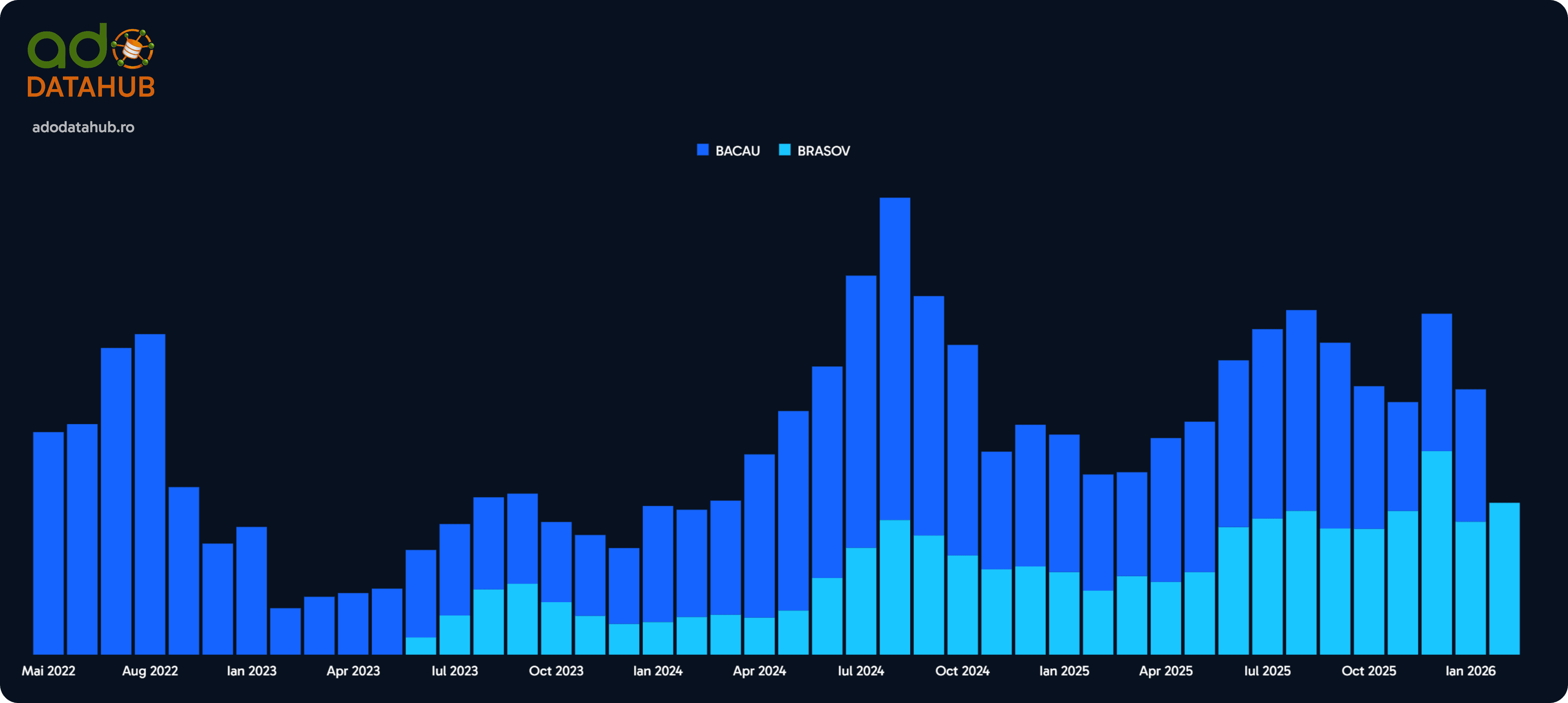
The January 2026 data reinforces this conclusion. Brașov reached 33,598 passengers, while Bacău recorded 33,443. The difference is minimal — only 155 passengers, or approximately 0.46% in favor of Brașov — but its analytical value is significant. If Brașov clearly surpassed Bacău in December and maintains at least the same level in January, we are no longer dealing with a one-off anomaly, but with a new competitive balance.
Looking at the broader trend, the series highlights two very different profiles. Bacău shows a more stable evolution, with seasonal fluctuations but no major acceleration. Brașov, on the other hand, follows a typical expansion curve: it starts from a lower base, grows rapidly, consolidates its new level, and begins to directly challenge already established airports. This is the real stake of the comparison — not that Brașov had a strong month, but that it closed the gap in a very short period of time.
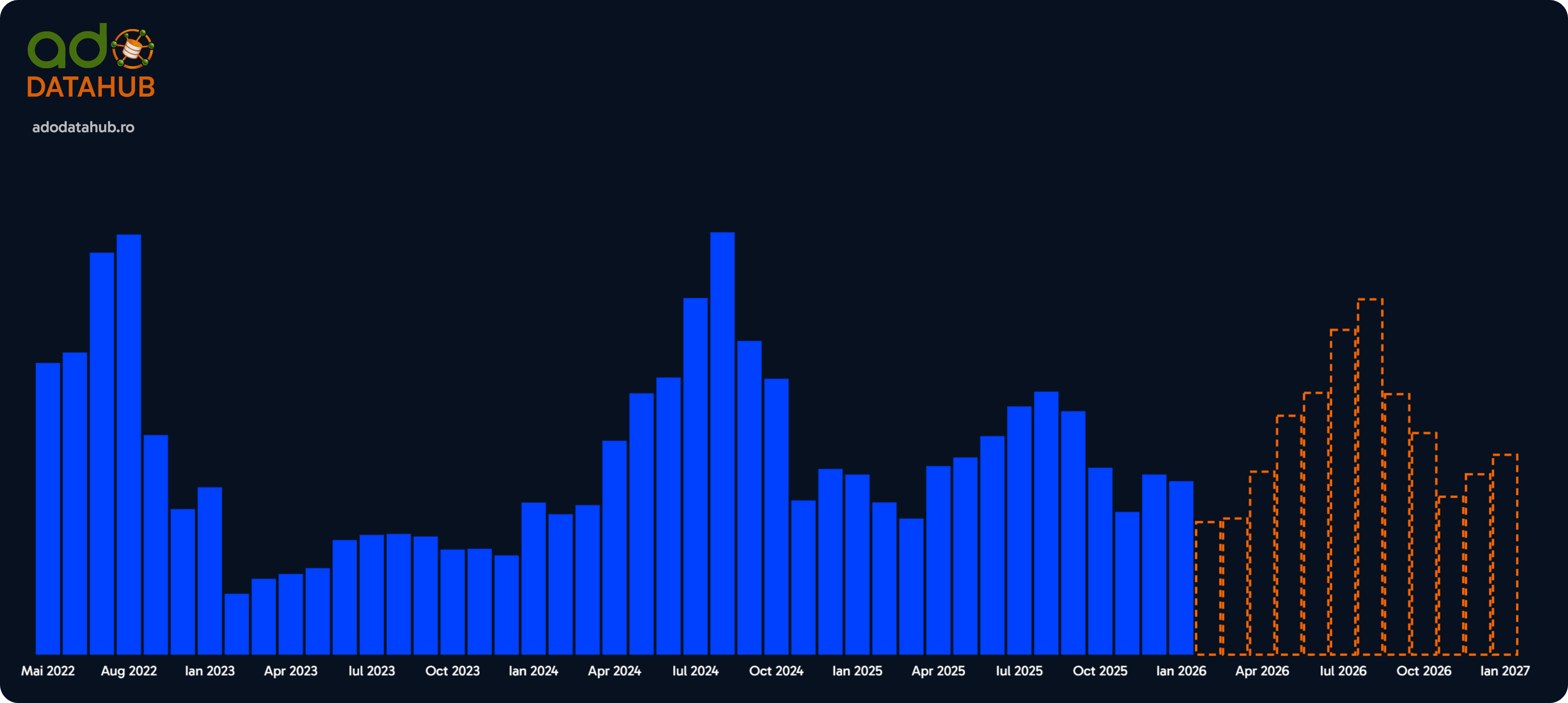
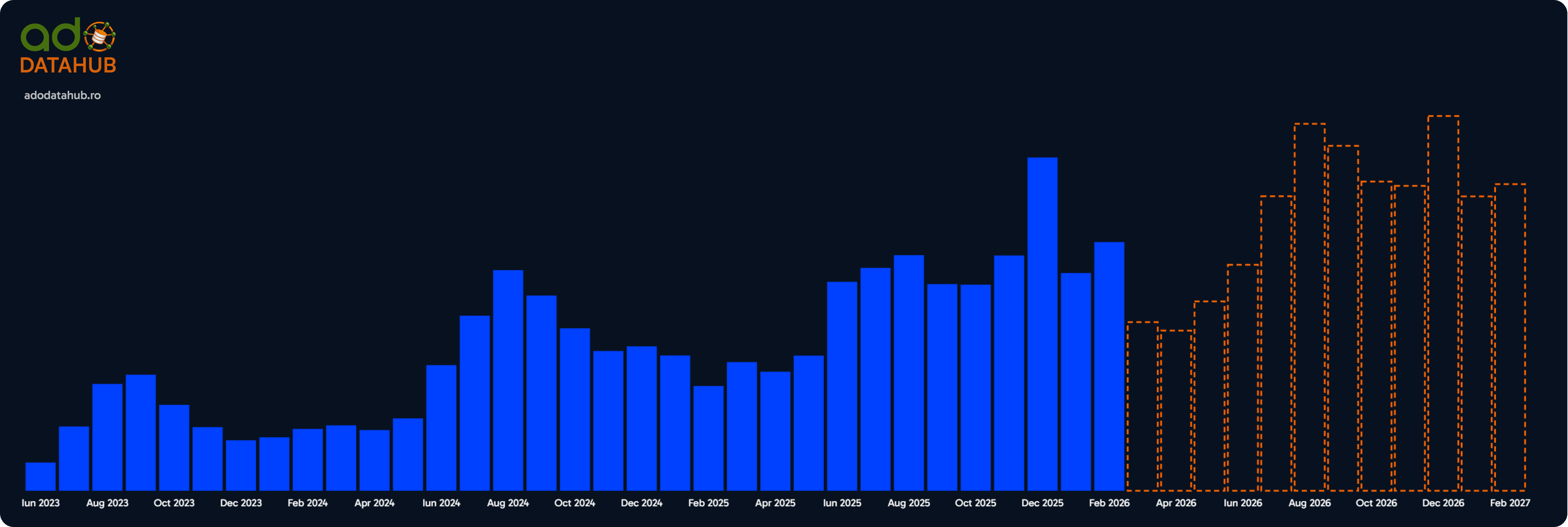
The forecast adds even more weight to this picture. The projection for December 2026 indicates approximately 57,821 passengers for Brașov. Compared to December 2025, when the airport recorded 51,420 passengers, this represents an estimated increase of around 6,401 passengers, or roughly 12.4% year-over-year. In other words, the model does not suggest a plateau, but a continuation of the upward trend even after an already strong year.
This detail is essential. Typically, after a rapid growth phase, many new projects begin to slow down. In Brașov’s case, the forecast does not indicate a strong correction, but rather consolidation at a higher level. This suggests that the market is absorbing the current capacity well and that there is room for further growth.
At the same time, there is also an operational context that strengthens this story. The airport currently operates with 3 aircraft parking positions, and expansion plans aim to add 5 more, bringing the total capacity to 8 aircraft. This represents a capacity increase of approximately 166.7%. This is not a minor technical detail, but a clear signal that development is being designed not just for current demand, but for significantly higher traffic volumes and more flexible operations.
The link between traffic and infrastructure is direct. An airport may have demand, but without sufficient operational capacity it cannot scale. The fact that Brașov is entering this expansion phase at a time when the data already shows outperformance versus Bacău and a positive forecast for 2026 reinforces the idea that growth is supported from multiple angles: traffic, commercial interest, and infrastructure capacity.
The conclusion drawn from the data is both strong and simple. Brașov is no longer just a new airport trying to find its place. In December 2025 it outperformed Bacău by 48.1%, in January 2026 it remained ahead — even if marginally — and the forecast points to a new level of around 57,821 passengers by December 2026. This indicates that the airport is not only growing, but also repositioning itself within Romania’s regional aviation landscape.
Brașov is no longer just a recently launched airport. The data already shows an airport that validates its investment, rapidly closes gaps, and enters direct competition with established regional benchmarks.